




PVDF Polyvinylidene fluoride Kynar®
DESCRIPTION
PVDF is a semicrystalline thermoplastic fluoropolymer that is highly resistant to chemicals, abrasion, flames, and UV. It is a basic material for use in the chip making industry for laboratory benches and equipment. It is also used as tank liners, seals and gaskets, pump and valve parts. PVDF is available both as a homopolymer and a copolymer blend. The homopolymer is high in strength, is stiffer, and has a higher heat f=deflection temperature. The Copolymer has superior impact strength and stress crack resistance. Kynar, a brand established by Arkema is one of the common trade names for PVDF.
PRIMARY SOURCE

About the supplier:
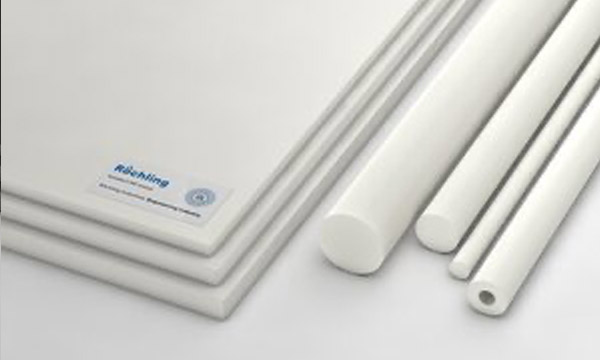
Rochling SE & Co. is our primary source of PES stock shapes
Characteristics
- High temperature resistance
- Good weldability
- Chemical resistant
- Good heat ageing resistance
Industries
- Chemical Processing Industry
- Clean-Room Technology
- Galvanic plants
- Chemical storage tanks
DETAILS:
| Gage, mm | Width x Length, mm | ||||||
|---|---|---|---|---|---|---|---|
| 1 | 1000 x 2000 | ||||||
| 2 | 1000 x 1000 | 1000 x 2000 | |||||
| 3 | 1000 x 2000 | 1500 x 3000 | |||||
| 4 | 1000 x 1000 | 1000 x 2000 | 1500 x 3000 | ||||
| 5 | 1000 x 2000 | 1500 x 3000 | |||||
| 6 | 1000 x 2000 | 1500 x 3000 | |||||
| 8 | 1000 x 2000 | 1500 x 3000 | 2000 x 6000 | ||||
| 10 | 1000 x 2000 | 1500 x 2000 | 1500 x 3000 | 2000 x 6000 | |||
| 12 | 1000 x 2000 | 1500 x 3000 | |||||
| 15 | 1000 x 2000 | 1500 x 3000 | 2000 x 4000 | 2000 x 6000 | |||
| 20 | 1000 x 2000 | 1500 x 3000 | 2000 X 3000 | ||||
| 25 | 1000 x 2000 | ||||||
| 30 | 1000 x 1000 | 1000 x 2000 | 1500 x 3000 | 2000 X 3000 | 2000 x 4000 | ||
| 35 | 1000 x 2000 | 2000 x 6000 | |||||
| 40 | 1000 x 1000 | 1000 x 2000 | 2000 x 4000 | 2000 x 6000 | |||
| 50 | 1000 x 1000 | 1000 x 2000 | 2000 x 4000 | 2000 x 6000 | |||
| 60 | 1000 x 2000 | 2000 x 4000 | 2000 x 6000 | ||||
| Test method | Unit | Guideline value | |
|---|---|---|---|
| General properties | |||
| Density | DIN EN ISO 1183-1 | g/cm³ | >1.75 |
| Water absorption | DIN EN ISO 62 | % | <0.4 |
| Flammability (Thickness 3 mm / 6 mm) | UL 94 | V0 | |
| Mechanical properties | |||
| Yield stress | DIN EN ISO 527 | MPa | >50 |
| Elongation at break | DIN EN ISO 527 | % | >30 |
| Tensile modulus of elasticity | DIN EN ISO 527 | MPa | >2100 |
| Notched impact strength | DIN EN ISO 179 | kJ/m² | >13 |
| Shore hardness | DIN EN ISO 868 | scale D | >75 |
| Thermal properties | |||
| Melting temperature | ISO 11357-3 | °C | 172...175 |
| Thermal conductivity | DIN 52612-1 | W/(m K) | 0.19 |
| Thermal capacity | DIN 52612 | kJ/(kg K) | 1.2 |
| Coefficient of linear thermal expansion | DIN 53752 | 10⁻⁶/K | 100...140 |
| Service temperature, long term | Average | °C | 0...140 |
| Service temperature, short term (max.) | Average | °C | >145 |
| Vicat softening temperature | DIN EN ISO 306, Vicat B | °C | >140 |
| Electrical properties | |||
| Dielectric constant | IEC 60250 | 8 | |
| Dielectric dissipation factor (10² Hz) | IEC 60250 | 0.02 |

Request a Quote
Meyer Plastics is a multifunctional plastic supplier combining the best parts of plastic distribution with excellent plastic manufacturing. Let’s get to work! Connect with us using this form, or tell us more about your upcoming project, and we will be in touch shortly.
Please, No Solicitations. Thank you.
"*" indicates required fields